
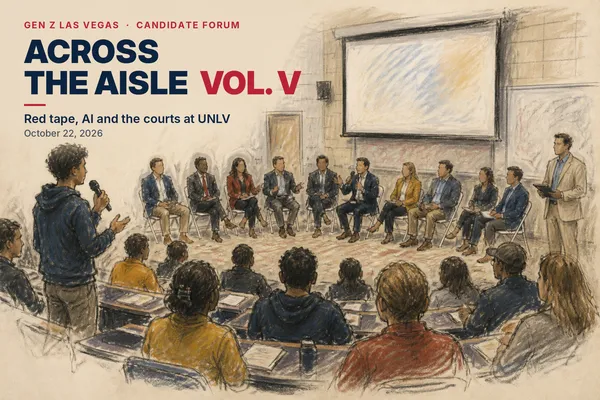
Across the Aisle Vol. V: Red Tape, AI and the Courts at UNLV
Twenty-one candidates, from Municipal Court to Congress, took questions from Gen Z voters, two subject matter experts and each other at the fifth Across the Aisle forum.
What would it take to open a small business in Clark County without waiting months for a license? Who should pay for the power plants Nevada's data centers will need? And when someone in court says a recording is an AI fake, how does a judge decide?
Those questions filled Room A112 of UNLV's Carol C. Harter Classroom Building on Thursday, October 22, 2026, when the Gen Z Coalition of Las Vegas held Across the Aisle Vol. V. Twenty-one candidates for city, county, state, federal and judicial office sat for nearly two and a half hours of introductions, moderator questions, expert follow-ups and open audience Q&A. The forum was co-hosted with College Republicans at UNLV and the Libertarian Party of Nevada, moderated by GZLV chair Marlon A. Medina, and livestreamed on YouTube.
At a glance
When and where: Thursday, October 22, 2026, 6 to 9 p.m., UNLV, Carol C. Harter Classroom Building A, Room A112
Hosted by: Marlon A. Medina, chair of the Gen Z Coalition of Las Vegas (GZLV)
Co-hosted by: Kean Allen Dino, College Republicans at UNLV, and the Libertarian Party of Nevada
Sponsors: Libertarian Party of Nevada, PodLab LV, We the People Marketing and Danielle A. Tarmu
Subject matter experts: Tony Benton (technology and AI) and Apolonia Piña (commercial real estate), with submitted questions from Noah Lechuga (housing)
Format: 60-second introductions, 60- to 90-second answers, expert follow-ups and audience questions, livestreamed on YouTube
Who took the stage
Panels are listed in the order they took the stage.
Panel | Candidate | Office sought |
|---|---|---|
Municipal Court | Amanda Pellizzari | Las Vegas Municipal Court, Dept. 1 |
Municipal Court | Matt Walker | Las Vegas Municipal Court, Dept. 1 (incumbent) |
Municipal Court | Jessica Green | Las Vegas Municipal Court, Dept. 2 |
Board of Regents | Stephanie Molina | Board of Regents, District 5 |
Board of Regents | Patrick Villa | Board of Regents, District 2 |
Federal and state | Rafael Arroyo | Nevada State Senate, District 12 |
Federal and state | Bobby Khan | U.S. House, Nevada District 1 |
Nevada Assembly | Kamilah Bywaters | Assembly District 2 |
Nevada Assembly | Gage Beck | Assembly District 13 |
Nevada Assembly | Tighe Galvin | Assembly District 21 (Libertarian) |
County services | Lynn Marie Goya | Clark County Clerk (incumbent) |
County services | Howell Shaw | Clark County Clerk |
County services | Steven Borella | Clark County Recorder |
State Treasurer | Tya Mathis-Coleman | Nevada State Treasurer |
District Court | Jacob Reynolds | District Court, Dept. 29 (incumbent) |
District Court | Josh Santeramo | District Court, Dept. 30 |
District Court | Joanna S. Kishner | District Court, Dept. 31 (incumbent) |
District Court | Danielle A. Tarmu | District Court, Dept. 28 |
District Court | Austin Beaumont | District Court, Dept. 8 |
Family Court | Kerri Jean Maxey | Family Court, Dept. N (incumbent) |
Family Court | Marilyn A. Caston | Family Court, Dept. R |
Judicial races are nonpartisan; party labels appear only where a candidate stated one.
Opening the night
Marlon A. Medina, GZLV's chair and the forum's moderator, opened by thanking attendees for making it to campus "against all odds, the wind, the rain, the traffic." He framed the series around accountability: every Across the Aisle forum is recorded, so voters can go back and check what candidates said.
He also named what made Volume V unusual. GZLV is nonpartisan, but this forum was co-hosted with College Republicans at UNLV and sponsored by the Libertarian Party of Nevada. "This is not a middle ground organization," he said. "We're not trying to get everyone to the center. What we're really trying to do is just make sure that we can hear each other and have peaceful dialogue."
Sponsors and co-hosts
Libertarian Party of Nevada, key sponsor. Tighe Galvin, chair of the Clark County Libertarian Party and the Libertarian candidate for Assembly District 21, spoke briefly, arguing that voters are looking for alternatives to the two-party system.
PodLab LV, red carpet media sponsor, ran post-panel candidate interviews in the next room.
We the People Marketing, livestream sponsor, produced the YouTube broadcast.
Danielle A. Tarmu, supporting sponsor, who is also a District Court candidate. Medina noted she reached out to sponsor and later chose to increase her sponsorship.
Co-host Kean Allen Dino of College Republicans at UNLV said the goal was simply to bring candidate information to students on campus, not to stage a partisan event. Organizers added that Democratic candidates have attended past forums, including a CD2 candidate who drove down from Reno for Volume IV.
Subject matter experts
New this season, GZLV invited experts to question candidates alongside the moderator:
Tony Benton, a startup founder working in technology, focused on AI and data.
Apolonia Piña, a Las Vegas commercial real estate owner, focused on small business, development and access to services.
Noah Lechuga, a housing and real estate expert who joined Volume IV, could not attend because of work. Medina read his submitted questions where time allowed.
Invocation and ground rules
Though the forum is secular, Medina said he wanted to start the night with "the right energy," and invited his friend Pastor Ed Van Meter of Community of Christ to open in prayer.
Van Meter said he has been "working with [youth] since 1978." He served in the Army from 1978 to 1999, surrounded by people in that same age group, and watched them grow into leaders because they were properly informed and wanted to serve their communities. Now, he said, he gets to do it again, and his own daughter is part of Gen Z.
His prayer asked for wisdom and, "most of all, truth" for everyone in the room. He prayed for the candidates and young people who had gathered, reminding them that even a small group "is as powerful as ten voices."
Medina then laid out the format: 60-second introductions, 60 to 90 seconds for answers to common questions, 30-second follow-ups when invited, and audience questions. His ground rules were short: be respectful, be mindful that you're on a livestream, and stay focused.
The panels, part one: city courts to county records
The night ran in a different order than the printed program. The Municipal Court panel went first so a candidate could leave early for a family matter, and the planned recess was dropped to keep the evening on time.
Las Vegas Municipal Court
Amanda Pellizzari (Department 1), Matt Walker (Department 1, incumbent) and Jessica Green (Department 2)
The three candidates introduced very different paths to the same bench:
Pellizzari has been a criminal defense attorney for more than 18 years. She said the city's bench has traditionally been filled by former prosecutors, and pitched herself as "an outsider" who has represented the people who come through the court.
Green has practiced locally for 15 years and served as a pro tem judge, logging more than 1,000 hours on the bench. She was appointed interim hearing master in 2022 and has handled every specialty court in the building.
Walker was appointed to the bench in 2025 after nearly 20 years in Municipal Court. As a prosecutor he started a psychiatric stabilization program that he said helped more than 500 defendants, and he now oversees the Veterans Treatment Court.
Asked how a court helps people understand what to do next, all three stressed patience and plain language. Green said a judge should make sure people understand "how we arrived at that outcome," even when they dislike it. Walker noted that many people in Municipal Court are in the criminal justice system for the first time. Pellizzari pointed out that anyone facing possible jail time has a right to appointed counsel, so most defendants have a lawyer.
Tony Benton asked what a court should do when someone claims a recording is an AI fake. Walker said judges rely on the parties and weigh the credibility of the evidence and experts each side brings. Pellizzari walked through the rules of evidence: a video must be authenticated, the burden never falls on the defendant, and defense experts need funding. Green added that "it takes a long time for law to catch up to tech."
Apolonia Piña asked what the court can offer business owners who can't afford a lawyer. Walker and Green explained that businesses usually appear as crime victims, so prosecutors carry the case; in civil abatement matters, owners can appear on their own. An audience question about the Veterans Treatment Court drew a detailed answer from Walker: it is a voluntary 12- to 18-month sobriety program, and charges are dismissed for those who complete it. Green noted that her department's specialty court is the Young Offenders Court.
Board of Regents
Stephanie Molina (District 5) and Patrick Villa (District 2). Robert E. Hutchinson (CCSD District F) did not attend.
Molina has been a student, employee and workforce development staffer within the Nevada System of Higher Education. She wants to grow non-credit community training as a revenue source to help keep tuition low.
Villa has taught math at the College of Southern Nevada for 22 years. He named campus safety and security as his top priority.
On student outcomes, Villa cited placement data he called frustrating: in his account, 90% of incoming CSN students were not college-ready in math. He wants to focus on students who come within a few classes of finishing. Molina tied outcomes to whether degrees lead to jobs. Asked why Nevada education ranks low, Villa pointed to 30 years of rapid growth.
The AI questions split the two. On whether a responsible-AI course should be required for graduation, Molina said it should be optional, while Villa liked the idea but warned that credit limits mean "something's gotta go." On whether boards should publicly vote before an AI tool reaches students, Molina said it should not need a vote, and Villa said he would welcome the discussion but needs to learn more first.
Piña asked about students who excel with their hands rather than on tests. Both pointed to NSHE's credit for prior learning. Candidate Bobby Khan, from the audience, pressed for funding stand-alone trade certificates. Villa said certificate programs such as CSN's diesel and automotive tracks already skip general education requirements. A recent graduate asked how UNLV justifies parking fees on a largely commuter campus. Both candidates said they would look into where the fees go, and Villa called the current costs unfair.
Federal and state representation
Rafael Arroyo (State Senate District 12) and Bobby Khan (U.S. House, Nevada District 1). Joe Ludwig (Assembly District 29) did not attend.
Arroyo, a small business owner and father of five who has lived in Las Vegas since 1991, said the city is "going in the wrong direction" and called for accountability in how public money is spent and how agencies perform.
Khan, a businessman, said he decided to run after concluding that politicians on both sides answer to donors.
On lowering everyday costs, Arroyo pledged not to raise taxes and to cut inefficient spending, noting that falling tourism is reducing state revenue. Khan focused on permitting delays, saying red tape drives businesses and housing projects away.
Piña asked what would cut the cost of doing business. Arroyo described a three-month licensing lead time for entry-level workers in his own industry. Khan called for expedited visas for high-spending international visitors and criticized the Nevada Gaming Commission. On Tony Benton's question about who should pay for power plants and lines for data centers, both said the companies should pay, not ratepayers. Khan also objected to siting data centers on public land.
Medina noted that both are returning participants whose opponents have never accepted an invitation. Arroyo said incumbents find it easier to rely on lobbyist-funded attack ads than to face voters. Khan answered that "every candidate should be required to debate." An audience member asked how to encourage competition in resorts and homebuilding. Khan proposed capping any company at two Strip megaresorts. Arroyo called for opening markets to new competitors.
Nevada Assembly
Kamilah Bywaters (District 2), Gage Beck (District 13) and Tighe Galvin (District 21, Libertarian). Anthony Scott "Red" Willett (District 7) did not attend.
Bywaters, born and raised in Las Vegas, is a doctoral student in education at UNLV.
Beck described himself as "an activist candidate" focused on a few key issues.
Galvin, a CCSD special education teacher and the son of immigrants, called for auditing state government, keeping taxes low and breaking up CCSD.
Asked which state law they would change first, Galvin named the NV Energy monopoly, which he said has raised rates and hurt solar. Beck wants Nevada National Guard members to be able to request a military trial; he said a bill to do that died on the floor last session. Bywaters wants to pay salaries to school board trustees and regents, and to expand mental health prevention.
The trustee salary idea produced the forum's most direct exchange. Galvin opposed it, citing administrative bloat in public education. Bywaters responded that unpaid trustees juggling other jobs cannot fully do the work the community expects of them.
On Piña's question about permitting for small businesses, Beck proposed one business license valid across all of Clark County. Galvin said bureaucrats should not decide whether a business opens where safety isn't at stake. Bywaters suggested small business incubators. Asked by Benton for one AI safeguard to write into state law, Beck would clarify that AI-generated speech is not protected by the First Amendment. Galvin wants independent audits of government AI use. Bywaters wants AI tools to be safe, factual and not replace human jobs.
County services
Lynn Marie Goya (Clark County Clerk, incumbent), Howell Shaw (Clark County Clerk) and Steven Borella (Clark County Recorder)
Goya, a former freelance journalist, is seeking re-election as clerk.
Borella called the recorder's office "the most important office we have in local government" because it protects property records. He wants the fraud alert service, which now sends emails, to send text messages.
Shaw, a product designer turned teacher and pastor, said his design background would make the office's interfaces easier to use.
Goya said her top project is a Google-like search engine for county records, which she hopes to launch by the end of the year. Borella wants to publish recorded documents on a blockchain so owners can verify a record hasn't changed. Shaw noted that Clark County weddings have fallen from about 120,000 a year at their peak to roughly 72,000, and proposed branding Las Vegas as the "wedding and anniversary capital of the world." Goya said her office already issues vow renewal certificates and hosts an annual vow renewal event.
Piña, who often visits county offices for real estate records, asked how to make records easier to find online. Borella said older records still need to be digitized and the website made mobile friendly. Goya said her office is nearly done digitizing an archive dating to 1909, but stressed keeping a person available by phone and email. Shaw would change state law to allow virtual wedding license appearances.
The panels, part two: public funds and the courts
Sponsor spotlight
In place of the recess, sponsors took a minute each. Galvin invited attendees to join the Clark County Libertarian Party. Medina described We the People Marketing as the civic arm of his marketing agency. Hiram of PodLab LV explained the studio's work producing video for business founders and invited candidates to record interviews. Danielle A. Tarmu, a civil litigator of nearly 20 years running for District Court Department 28, said she is running because the bench has too few judges with civil litigation backgrounds.
State Treasurer
Tya Mathis-Coleman. Tim "TJ" Ferreira (Clark County Treasurer) did not attend, and no representative for Minja Yan (County Commission District F) took part.
Mathis-Coleman, Nevada's deputy state treasurer for six and a half years, said she is the only candidate in the race with experience in that office. She grew up in Las Vegas, attended UNR on a Millennium Scholarship and holds two UNLV degrees.
The decision she is proudest of, she said, was refocusing the office beyond Clark and Washoe counties to serve rural Nevada. She wants to modernize office systems, one of which dates to 1999, and urged young people to check whether they have unclaimed property with the state.
Piña asked how to prioritize infrastructure for both growing areas and older commercial corridors. Mathis-Coleman clarified that the treasurer manages investments rather than deciding where money is spent. She pointed to the State Infrastructure Bank, which she said has helped create 10,000 affordable housing units in northern Nevada, and said she wants to use it for rural hospitals and schools. On Benton's question about whether the public should see what each data center tax break costs, she said yes: "It's public dollars being spent."
District Court
Judge Jacob Reynolds (Department 29), Josh Santeramo (Department 30), Judge Joanna S. Kishner (Department 31), Danielle A. Tarmu (Department 28) and Austin Beaumont (Department 8). Jasmin Lilly-Spells (Department 23) was on the roster but did not join this panel.
Organizers combined the District Court candidates into one panel on the spot.
Reynolds, a judge for about three years, said he has bipartisan support and wants voters to look for "people of competence, not people who are any political party."
Santeramo, a first-time candidate, said most voters tell him they know nothing about judicial candidates when they reach the ballot, which is why forums like this matter.
Kishner has served in Department 31 for 15 years and cited more than 43 organizational endorsements.
Tarmu said voters too often ask judges about party when knowledge, experience and respect for everyone in the courtroom matter more.
Beaumont, a prosecutor and trial attorney who previously ran hotels, said he is running to fix problems in Department 8. He cited media criticism of the incumbent's temperament and warned against judicial activism. The incumbent was not present to respond.
Asked how to move a crowded docket while giving each side a fair hearing, the candidates traded concrete practices:
Reynolds issues tentative rulings two or three days ahead, which he said can cut hearings from 30 minutes to five, and grants summary judgment where the evidence doesn't merit a trial.
Santeramo stressed reading every brief beforehand and using status checks and the senior judge settlement program.
Kishner described staggered calendars, special settings for long matters, and letting pro bono attorneys go to the front of the line.
Tarmu would hear undisputed matters first and save long arguments for later.
Beaumont said the county spent roughly $14 million to $15 million on remote hearing technology during COVID that most judges stopped using, and he wants it used again.
Family Court
Judge Kerri Jean Maxey (Department N) and Marilyn A. Caston (Department R)
Maxey represented children for 19 years, first as a public defender and then at Legal Aid Center of Southern Nevada, where she helped create the Minor Guardianship Program.
Caston, a family law attorney, called Family Court "by far one of the most congested" courts and said families in crisis need faster temporary orders.
Benton asked what a court should require before using a recording one side says is fake. Caston said Family Court already struggles with edited screenshots and texts, and AI makes it harder; co-parenting apps that log when messages are sent help. Maxey noted that a judge cannot question an exhibit's authenticity unless the other side objects.
Piña asked how courts can make sure shared real estate and business assets are fully disclosed in a divorce. Caston said judges need to impose consequences on parties who hide assets. Maxey said she tells litigants there is "no Perry Mason moment," and that a court can draw a negative inference when assets go undisclosed.
An audience member asked whether Family Court is stacked against men. Maxey said custody decisions rest on the child's best interest, with Nevada presuming joint legal custody and preferring joint physical custody regardless of the parents' gender. Caston described a change in state law that ended what she called "de facto custody," so both parents now start on equal footing. She added that alimony and child support follow statutory factors and formulas.
Open Q&A and the benediction
The last 15 minutes opened the floor to anyone in the room, and the questions turned from policy to the state of the country.
One attendee asked what candidates would say to a generation that feels polarized and detached. Judge Reynolds pointed to jury trials, where people serve "because they're Americans," not as partisans, and said he believes people "are more united against this problem than we are divided." Arroyo urged young people to spend time in tight-knit communities and to practice civil disagreement. Borella told students that today's decisions shape whether they will one day own a home or business. Galvin urged voters to choose candidates they believe in rather than "the lesser of two evils." A judicial candidate closed the round by asking Gen Z to vote, serve on juries and serve their community.
Another attendee raised gender relations and declining marriage rates. Galvin said he would rather focus on "bread-and-butter issues" and that government should stay out of people's personal lives.
The final question asked a judicial candidate to interpret Question 6, a proposed constitutional amendment on abortion. The candidate declined, explaining that Nevada's Code of Judicial Conduct bars judicial candidates from giving political opinions on ballot questions, and that district courts do not legislate. It was a useful reminder of why judicial forums look different from legislative ones.
Closing benediction
Sharelle Mendenhall, a TV host and speaker, closed the evening in prayer. She thanked every person who chose to run, for state office, county office or the bench, and asked that those who win "set aside every selfish ambition" and "truly stand up for what is right." Her prayer ended on the forum's own theme: that people could "truly be across the aisle and bring honor back to the table again," standing up for one another instead of tearing each other down, "because we truly are better together."
What ran through the night
Across eight panels and five levels of government, four threads kept coming back.
Cost of living and red tape. Nearly every non-judicial candidate tied affordability to how hard it is to start or run something in Nevada. Arroyo and Khan focused on taxes and permitting, Beck on a single countywide business license, and Galvin on the NV Energy monopoly. Piña's questions kept the focus on small business owners trying to get through the process.
AI, from classrooms to courtrooms. Tony Benton's questions turned up real disagreements. The Regents candidates split on whether AI courses or tools should be mandated, and Assembly candidates offered three different safeguards. On one question there was no split at all: every candidate asked said data center companies, not ratepayers, should pay for the power infrastructure they need. In the court panels, judges and challengers agreed that the rules of evidence already apply to AI-altered recordings, while acknowledging that courts are still catching up.
Access and transparency. County and court candidates kept returning to the same question: can an ordinary person find what they need without a lawyer or a trip downtown? Answers included a public records search engine, text-message fraud alerts, remote hearings, tentative rulings issued in advance, and a treasurer's office that publishes what tax breaks cost.
Competence over party. The judicial candidates repeatedly asked voters to judge them on experience and temperament rather than party, and declined to weigh in on Question 6 for that reason. Several non-judicial candidates echoed the point in their own way, calling for civil disagreement and for every candidate to show up and debate.
Where candidates disagreed, they did it to each other's faces and stayed in their seats. The sharpest exchange of the night, Bywaters and Galvin on paying school board trustees, ended with Medina thanking them "for the friendly conversation."
Who shows up, and who doesn't
Across the Aisle has never measured success by the size of the crowd. It measures it by who is willing to sit in the chair. Several candidates were asked, on the record, why their opponents never come. That empty-chair question is the point of the series: a recorded forum where anyone can check, years later, who showed up and what they said.
Speaking with the Scarlet and Gray shortly after the event, Medina was asked what would bring more people to the next forum. His answer was collaboration. Help from the partisan state and county groups would be greatly appreciated, he said. With the exception of the Libertarian Party, though, GZLV has found the state and county Democratic and Republican parties less willing to work with it. That is why GZLV invites candidates directly, rather than going through their parties or campaign managers.
That approach is why Volume V looked the way it did: a campus Republican club co-hosting, a Libertarian sponsor, an independent coalition moderating, and a stage where nobody was asked to agree. The invitation stands for every party and every candidate. The chairs are there; the only question is who fills them.
GZLV plans to return in the new year with a forum that checks in on how the winners of this election are doing in office.
Watch and vote
Watch the full forum on YouTube: Across the Aisle Vol. V livestream.
Before you vote, check registration, early voting locations and Election Day details with the Nevada Secretary of State's elections page.
Stay in the loop for the next forum at GZLV.org.
This recap summarizes candidates' remarks from the October 22, 2026 livestream. Statements are attributed to the candidates who made them and were not independently fact-checked by GZLV. Sponsorship and participation do not constitute an endorsement by the Gen Z Coalition of Las Vegas.
Open dialogue. Civil debate. Equal voices.


